
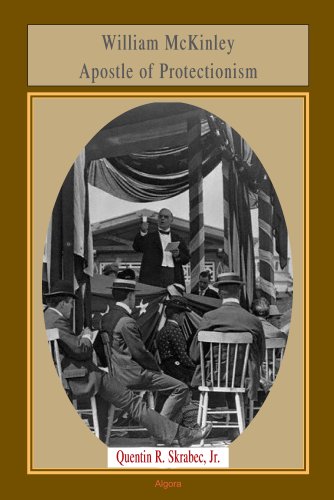
William McKinley, Apostle of Protectionism
Product details
| Management number | 233312315 | Release Date | 2026/06/27 | List Price | US$8.35 | Model Number | 233312315 | ||
|---|---|---|---|---|---|---|---|---|---|
| Category | |||||||||
Tariffs and protectionism versus free markets and immigrant labor...President Trump is juggling issues strikingly similar to those that faced President William McKinley 125 years ago. McKinley’s unusual view of protectionism, a labor-business alliance, and American exceptionalism, offers striking parallels to today. McKinley got the job done.President McKinley’s vision built the industrial base of the nation, making him one of America’s most popular presidents—with everyone from the bankers to the workers.He united a fractured America like few presidents before or after, yet McKinley has been in the shadow of his successor Theodore Roosevelt for over a hundred years. William McKinley was the first US president to address globalization; his balancing act blended free trade, protectionism, and immigration. He orchestrated an alliance between big business and the American worker that ushered in one of the greatest periods of growth ever known in the US economy. His legacy in protectionism and immigrant labor offer lessons for the current era. As Chairman of the Ways and Means Committee, McKinley had forged a tariff bill in 1888 that united a nation that was still divided between North and South, East and West. His continued efforts to support free trade, protected by managed markets in the tradition of Henry Clay, and worker benefits like those provide by George Westinghouse, led to a great economic compromise. Further, with revolutionary, visionary rhetoric laden with America’s “economic manifest destiny” he appealed to everyone from the steelworkers of Pittsburgh to the New York bankers.He articulated a uniting philosophy: “Free trade in the United States is founded upon a community of equalities and reciprocities.” “Free foreign trade admits the foreigner to equal privileges with our citizens. It invites the product of foreign cheap labor to this market in competition with the domestic, representing better paid labor” (albeit with tariffs to protect that domestic product).McKinley’s vision and policies built our industrial base. By the end of his presidency the American steel, glass, rubber, oil, machinery and electrical appliance industries dominated the world.He was honored by bankers and workers alike. As his funeral train crossed the nation in 1901, factory workers as well as captains of industry stood along the rails to mourn him. Never since has such a political alliance between labor and management been forged.He was the last president to build a voting alliance between laborers, immigrant workers, and capitalists. That alliance was marred by famous labor strikes and the building of great trusts, yet he still managed to sweep the labor votes in the great industrial centers—due to his belief in reciprocity and protectionism. McKinley’s role as a “dinner pail” Republican offers insights into how the United States can approach today’s globalization with the best interests of the “home team” in mind.Author Quentin R. Skrabec Jr. has published over fifty articles on history, industrial history and business, and five books on the late 1800s and American business. This biography draws on ten years of research in the presidential library in McKinley’s hometown of Canton, Ohio. Primary sources reveal new information not published since the time of the McKinley Administration. Read more
| ISBN10 | 0875865763 |
|---|---|
| ISBN13 | 978-0875865768 |
| Language | English |
| Publisher | Algora Publishing |
| Dimensions | 6 x 0.64 x 9 inches |
| Item Weight | 1 pounds |
| Print length | 280 pages |
| Publication date | October 1, 2007 |


Customers who viewed this product also viewed
Trades & Tariffs


Correction of product information
If you notice any omissions or errors in the product information on this page, please use the correction request form below.
Correction Request Form